
The Texas Behavioral Health and Justice Technical Assistance Center (TXBHJ) connects Texans with resources related to behavioral health and justice services. The organization supports people working in Texas’s behavioral health and justice systems, as well as people with lived experience in these systems.
The Initiative
In December 2025, TXBHJ launched the Housing Learning Community, which ran through May 2026. This six-month program explored housing through the lens of the sequential intercept model (SIM). The program was designed to support multidisciplinary teams across Texas working to improve housing access for people involved in the justice system and living with mental illness, substance use disorders, or intellectual and developmental disabilities.
To participate in the program, organizations across Texas completed an online application answering a series of questions related to housing. TXBHJ reviewed the applications and selected participants for the program, which included local leaders, service providers, and system partners who gathered to explore housing challenges and solutions across the criminal justice system.
When evaluating applications, TXBHJ aimed to establish a learning community that included applicants from both rural and urban counties. The organization also prioritized launching a learning community that engaged a variety of stakeholders to ensure discussions included a wide range of input and perspectives. Some of the participating stakeholders included housing community representatives, law enforcement, and local mental health and behavioral health authorities.
TXBHJ partnered with Framework Strategies, who served as the subject matter expert throughout the program.
Challenges Identifying a Need for the Housing Learning Community
The need for this type of program stems from various emerging and ongoing issues, including recent policy changes and funding availability. Additionally, housing is often a topic of discussion in SIM workshops, where it’s often identified as a key priority for communities. However, implementation challenges remain an ongoing concern, as shown in the SIM Evaluation.
Many participants in the program cited the following problems in their communities as reasons for wanting to participate in the initiative:
- Lack of affordable housing or local options for transitional and recovery-based housing
- Fragmented coordination between housing providers, probation/parole officers, and service agencies
- Long waiting lists for public housing and vouchers
- Stigma and misunderstandings surrounding mental health challenges, substance use, and criminal backgrounds
- Few supportive services and wraparound supports
- Lack of housing within proximity to public transportation
- Lack of support in maintaining tenancy
The Housing Learning Community’s Structure
Throughout the program’s six-month duration, participants attended five virtual learning sessions supported by optional monthly office hours, which included consultations with subject matter experts and the option to present their real-life case examples to problem-solve with Framework Strategies consultants. The learning community wrapped up with an in-person closing meeting.
The Housing Learning Community used the SIM to identify key points where people can be diverted from the justice system into treatment and support services. The SIM is separated into 6 intercepts, which use the flow of the criminal justice system to frame the issues.
The topics of each session addressed housing needs at each intercept of the SIM, spanning from community services, contact with law enforcement, reentry and community corrections.
Highlights from the Housing Learning Community’s Sessions:
- Session One – Intercept 0 and 1, Community Services: This session highlighted the Texas Panhandle Centers (TPC) and their Projects for Assistance in Transition from Homelessness (PATH) program. Participants of this session learned about Intercepts 0 and 1 of the SIM, which include community-based services and crisis supports (Intercept 0), and initial encounters with law enforcement (Intercept 1).
- Session Two – Intercept 2, Initial Detention/Court Hearings: This session focused on Intercept 2 of the SIM model, which occurs when a person is detained by law enforcement and appears before a judge or magistrate for an initial hearing. Grayson County District Judge James Henderson and Community Diversion Coordinator, Elizabeth Groves, presented on the importance of prioritizing early action, informed judicial decision-making, and housing stability. These factors can prevent deeper system involvement and support more sustainable outcomes.
- Session Three – Intercept 3, Jails/Courts: This session highlighted Intercept 3 and examined how court decisions at this intercept affect housing stability for people with behavioral health needs. During the session, a community highlight presentation featuring the Texas Judicial Commission on Mental Health (JCMH) Court Liaison Program was presented by Daniela Jimenez Chisholm, senior staff attorney with JCMH, and Elizabeth Groves, community diversion coordinator for Grayson County.
- Session Four – Intercept 4, Reentry: This session highlighted Intercept 4, which focused on reentry into the community. Powerful community highlight presentations were given by Christina Edgar from the Texas Targeted Opioid Response (TTOR) and Janell Evans from 2-1-1 Texas Panhandle United Way, who also shared personal testimony of lived experience with reentry after incarceration. Their insights illuminated why housing stability is one of the most critical determinants of successful reentry, shaping behavioral health outcomes, supervision compliance, and long‑term community safety.
- Session Five – Intercept 5, Community Corrections: This session focused on Intercept 5 and the critical role housing plays in long‑term stability. The community highlight featured the Tennessee Department of Mental Health & Substance Abuse Services (TDMHSAS) and its Office of Housing & Homeless Services. The presentation wrapped up with Program Manager Gina Turley, who brought the Peer Housing Specialist (PHS) program to life, drawing on her 21 years of experience in the role.
- Session Six – In-Person Meeting: This gathering took place in Austin, Texas, and helped participants move from learning to implementation by turning insights from the Housing Learning Community into practical strategies and local efforts, strengthening cross system relationships, sharing practical approaches, and developing action plans to expand housing opportunities and reduce justice system involvement. Expert speakers offered their knowledge throughout the meeting, and attendees had the opportunity to participate in interactive activities to deepen their understanding.
Established Implementation Strategies to Address Housing Challenges in Texas
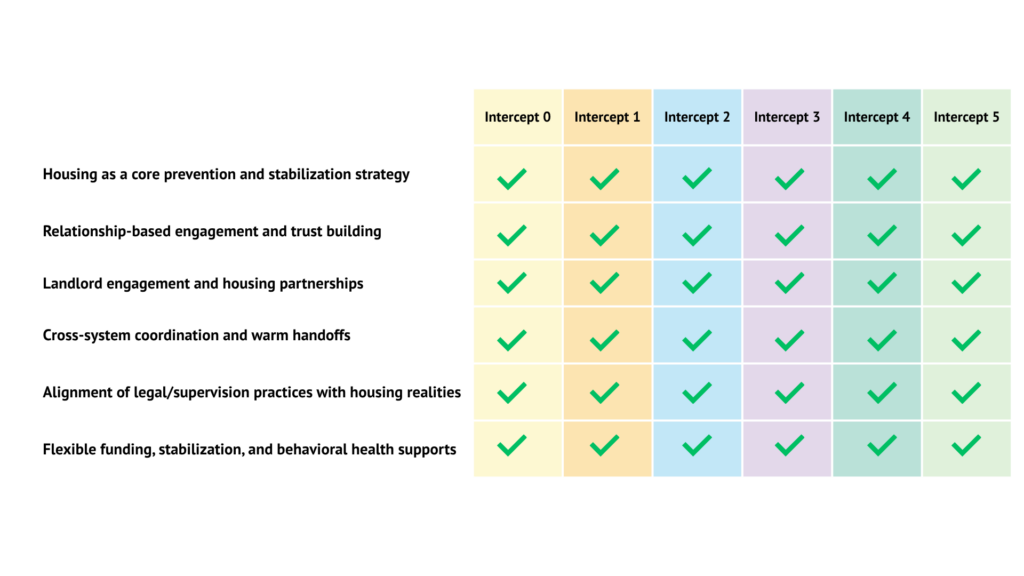
At the end of each session, participants developed implementation strategies to bring back to their communities to address their current housing challenges.
The following table represents the established housing solutions for all intercepts:
The Results
The Housing Learning Community’s virtual sessions had an average attendance of 22 participants per 90-minute session. TXBHJ aimed to foster an engaging environment in each session by facilitating thought-provoking conversations that inspired strategies for meaningful change among participants. This goal was achieved, as indicated by an average retention rate of 80%, with participants who joined at the start and remained until the end.
Other key takeaways from the virtual sessions:

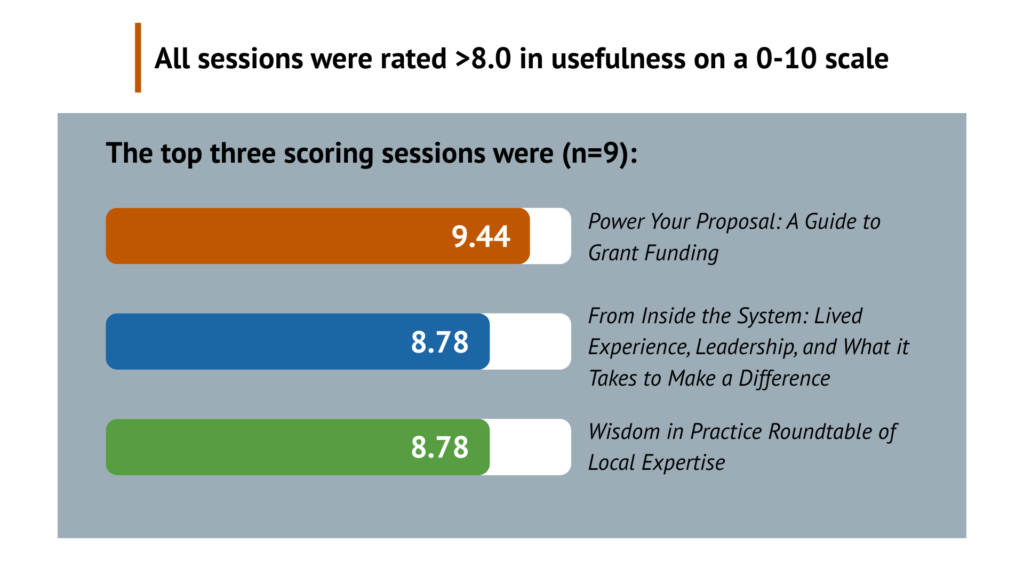
The housing learning community’s in-person meeting offered multiple sessions to assist participants in tackling housing challenges in their communities. 77% of attendees who completed the evaluation survey for the event said that it far exceeded their expectations.
Key takeaways from the sessions at the in-person meeting include:
The Impact of the Housing Learning Community
Through the Housing Learning Community, participants were able to embark on the unique opportunity to learn from other professionals across Texas and effectively develop strategies to establish housing stability in their communities.
To better understand the impact of the learning community, we included testimonials from participants who expressed the program’s benefits:
“…I found the sessions very helpful and appreciated information shared with the group and networking with my peers. I also appreciated the examples and guidance that were shared during the training. They made the content more practical and easier to apply.” – Tammy Hardegree, Howard County
“…I really enjoyed hearing how other areas address various housing challenges. I met people that I will continue to communicate with to inform our local processes – no need to reinvent the wheel! It is also inspiring to collaborate with smart, creative, people who care about those experiencing housing insecurity…” – Danice Obregon, Chief Public Defender, Nueces County
“…. (The Learning Community) helped me see the importance of addressing housing needs early and strengthening coordination between systems. The series gave me a deeper appreciation for the role housing plays in promoting stability and reducing system cycling or recidivism. I would highly recommend this learning community to anyone involved in housing, behavioral health, or justice-related work. The knowledge shared, networking opportunities, and collaborative discussions make it a worthwhile and meaningful experience…” – Ricardo Saravia, Bexar County
Stay in Touch with TIEMH
If you’d like to keep up with all of the institute’s projects, events, and mental health news, subscribe to our bimonthly newsletter.